“If people understood our product, they’d switch.”
Every launch team believes some version of this.
If physicians saw the data, they’d change how they practice. If payers understood the value, they’d cover it. If health systems understood the economics, they’d adopt it.
Different stakeholders. Same assumption: once people understand, they’ll change.
But understanding something new doesn’t give the market a reason to question what it already trusts.
And that matters when your ambition isn’t simply to launch a product, but to change the standard of care.
Healthcare markets don’t adopt a new standard all at once. They climb toward it.
First, the market questions the old way. Then it learns to judge the problem differently. Eventually, it prefers a new standard. Only then does that standard become how things are done.
That’s the Market Belief Ladder.
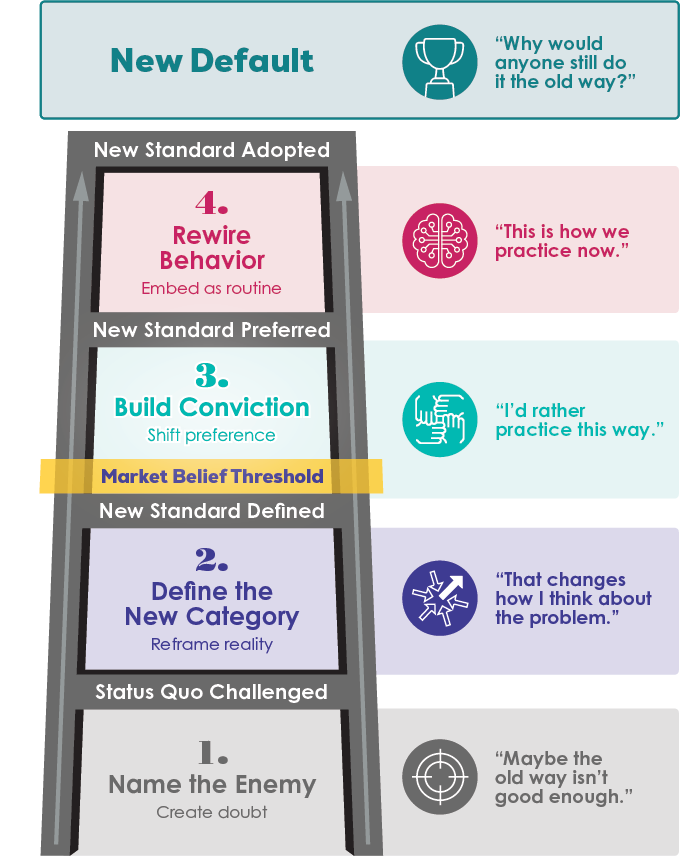
Along the climb is a threshold where resistance begins giving way to adoption. Most companies never reach it. Not because their innovation lacks value. Because they skip what has to happen first.
Today, we’re focusing on that first move.
Most launch strategies begin by explaining what’s new. What feature makes the solution better. What the data show. Why physicians should use it.
But if the market still believes the current way works, understanding your solution doesn’t create a compelling reason to change.
Markets don’t change until the status quo becomes difficult to defend.
So the first job isn’t making the market understand your solution. It’s giving the market a reason to question what it already accepts.
Awareness of the new solution isn’t the starting point. Dissatisfaction with the status quo is.
We call that Name the Enemy. It’s not a competitor. The enemy is what the market has learned to tolerate about the old way.
For decades, ambulatory cardiac monitoring largely meant a Holter monitor: record the heart for 24 hours and look for an arrhythmia.
But arrhythmias are intermittent. They don’t necessarily appear while a physician happens to be watching.
Most companies would have leaned harder on awareness: more evidence, more education, more effort to prove their product was better.
iRhythm made the limitation of the existing standard impossible to overlook:
What if a negative Holter didn’t mean there was no arrhythmia? What if it meant you stopped looking too soon?
In a prospective comparison, the 14-day Zio Patch detected 96 arrhythmia events versus 61 with a 24-hour Holter.
That didn’t just demonstrate Zio’s performance. It exposed what a short monitoring window could miss.
The question was no longer simply whether Zio was better.
It was: How long do you need to watch before you can confidently rule out an intermittent arrhythmia?
The old standard had become harder to defend.
Before your next launch discussion, ask:
What is the market currently accepting that our solution makes increasingly difficult to justify?
Markets don’t change because they understand the alternative.
They change when the current one becomes hard to defend.
Challenging the status quo creates an opening.
Naming the enemy is the first of four moves. Together, they’re how leaders engineer belief instead of waiting for the market to change on its own. We call it Belief Engineering.
But an opening doesn’t tell the market what should replace it.
If the old way has to go first, what standard should replace it?
Every market is already somewhere on the Market Belief Ladder. Most teams can’t say where. The Belief Engineering Framework maps all four rungs—and the threshold most companies scale past before their market has crossed it.



